No. 12 What Wedding Planning Taught Me About Sustainability
I got married this weekend. As you can probably imagine (or know from experience), wedding planning can be chaotic and stressful, especially on top of a demanding job. I wanted to share a few things that helped me find balance when life got really busy, and how this translates into work as a green building professional.
INNER SUSTAINABILITY INSIGHT
I'm one of those people who can't compartmentalize, which is when you divide your mind into neat little “boxes” so contracting thoughts and feelings don’t overlap. Nor is this a skill I care to learn. While compartmentalizing is healthy when used temporarily in high stress situations, it can lead to burnout in the long term. [1]
Being slammed with work projects is one thing, but when personal challenges get thrown into the mix too, it's easy to feel scattered. Here are three ways I created calm when both my personal and professional life were running full throttle:
1. “Good-enough” health habits. Doing simple things such as drinking water, gentle movement, eating well, to the best of my ability. While I didn’t have as much time for my delicious 60 min yoga sessions, I still got the health benefits with 15-20 minute sessions.
2. Actively recharging before big deadlines. Rest isn't something you reach for only when things are “done” and you're completely spent; it needs to be built into your day. For me, that meant building in relaxing activities such as massages and nature walks before the wedding.
3. Working through the fear of being seen. This was arguably the biggest thing that scared me about getting married - being the center of attention for a whole day! I worked through this fear with journaling, art, and somatic practices (which are body-centered techniques that help calm the nervous system and release physical tension stored by stress.) The outcome: I had a lot of fun connecting and celebrating with people on The Big Day, way more than my socially anxious self would have believed possible 6 months ago.
OUTER SUSTAINABILITY INSIGHT
Like weddings, sustainability initiatives tend to start with a lot of excitement and fanfare… and then, halfway through the project, the excitement fades and the initiatives get deprioritized.
American entrepreneur/ author Scott Belsky calls this the "Messy Middle" of innovation, and I think it applies to green buildings as much as it does to any new technology development. The middle stretch can become a grind: coordination fatigue sets in and things become a slog, especially with RFIs and Site Instructions flying in from every direction. The project team starts grumbling that green measures “slow the project down” and “cost too much”.
The way to keep sustainability top of mind through that middle stretch is to communicate its value beyond carbon savings.
For example, you're a structural engineer who wants to reduce embodied carbon from the foundation, and through efficient column layouts, you eliminate 1,000 cubic meters of concrete from the foundation. That translates to an embodied carbon saving of ~250,000 kilograms (about 250 metric tons) of CO2e from material savings (concrete and steel reinforcement), which is roughly equivalent to taking 60 gas-powered cars off the road for a year. [2]
When it comes to sharing project wins, most green building professionals stop there, which is exactly where the rest of the project team shrugs and says, "so what?"
That concrete savings also shows up in fewer trucks on site, less time on the pour, and real dollars saved. At a standard truck capacity of ~8 m³, that's about 125 fewer concrete truck deliveries. At a typical commercial pump rate of ~60 m³/hour, that's roughly 17 hours (about two full pour days) saved on placement alone. And in material costs alone (concrete + rebar, no labor), that's in the neighborhood of $320,000 CAD.
(All of these numbers (truck size, pump rate, and $/m³) vary by region, project scale, and site access; feel free to borrow my thinking process but don’t quote the numbers directly).
Suddenly, embodied carbon isn't a luxury; it's a way to keep the project on time and on budget while cutting carbon.
ART I’M MAKING
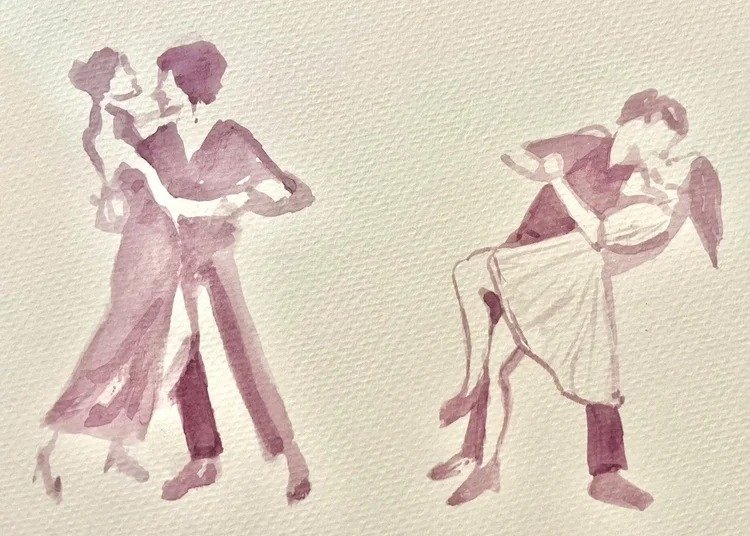
A watercolour sketch of dancers.
This one's a little different from what I usually share. For the past two weeks I've been practicing my first dance with my now-husband. I usually feel awkward when I dance, but my mindset during lessons was just to connect and have fun with my partner during some busy weeks.
Dancing has real wellbeing benefits, too: it builds strength and flexibility, gets the heart pumping, sharpens memory and improves mood.[3]
I laughed a lot in those sessions, so mission accomplished! The performance went well too. We remembered all the steps!
REFLECTION QUESTION
Think of a project you're in the "messy middle" of right now. What's one ripple effect of your sustainability work (beyond the carbon numbers) that could get your team to actually care?
Sources:
Jeung, D.-Y., Kim, C., & Chang, S. J. (2018). Emotional labor and burnout: A review of the literature. Yonsei Medical Journal, 59(2), 187–193.
Calculated with the EPA Greenhouse Gas Equivalencies Calculator
Harvard Mahoney Neuroscience Institute. (2015). Dancing and the brain. On The Brain, 21(1), 1–2. https://hms.harvard.edu/news-events/publications-archive/brain/dancing-brain