No. 13 Playing Your Opposites: Stretching Out of Your Comfort Zone
I just got back from my honeymoon, spending two week’s in Portugal and Albania, the latter being where I'm originally from. There's a lot I could tell you about: the absurdly azure water of the Albanian Riviera, Picasso’s light painting photographs at the Gjon Mili Museum, surfing the windy Atlantic ocean.
There's one part of the trip I want to tell you about properly, though.
Before we left Canada, we had booked exactly one accommodation.
I’m a planner who prefers to be packed three days before a trip. At minimum, I like to know where I'll be sleeping. So for the first stretch of this one, my nervous system was not on vacation. I kept feeling like I was doing my honeymoon wrong, as if there were a correct way to do it and I'd missed the memo.
I married someone who, in his words, "thrives in chaos." Somewhere along the way he helped me see this "mistake" as an adventure. On the third drive in a row where I was booking that night's place from the passenger seat, I caught myself thinking: This is kind of fun.
That brings me to this newsletter’s idea: playing your opposites.
INNER SUSTAINABILITY INSIGHT
Playing your opposites means doing something well outside your comfort zone, but in a small, contained way. You do it on purpose and for a short time, so it stretches you instead of swamping you.
Psychiatrist Dan Siegel calls the range where you can feel strong emotions and still think clearly your window of tolerance. Push past its edges and you tip into overwhelm or shutdown. Trauma therapists have since built on his idea, and they describe the window as something you can widen with practice: small, manageable doses of challenge, followed by a return to calm.¹ Over time, the thing that used to knock you over becomes something you can stay with.
This isn't about turning into your opposite, and it doesn't need to be a tidy 50/50 split. You're making room to leave your comfort zone in conditions where you still feel safe enough. Gradually, "unfamiliar" stops registering as "dangerous."
A few ways to try it:
If you're goal-oriented and always "on," try five minutes of aimless doodling. No result, no good drawing, no objective. It's a surprisingly effective way to switch off the part of you that's always optimizing.
If busy, many-moving-parts situations overwhelm you, recreate a low-stakes version on purpose. Cook a three-course meal once a week: three dishes, one stove, and a steady stream of small decisions. You'll build quick decision-making skills and the capacity to stay steady while things are happening all at once.
Partner with someone who's comfortable with the thing that scares you. Ideally, you're comfortable with something that scares them, so you each learn from the other.
OUTER SUSTAINABILITY INSIGHT
Playing your opposites works at work too. Try it with something you normally avoid or don’t enjoy. Start by scaling it down until it fits inside what your nervous system can handle.
If public speaking makes your stomach drop, find one group you already feel at ease with and offer to give a talk. It could be a guest lecture for students, or a short lunch-and-learn for colleagues you know and like. You're still presenting, but to the friendliest room you can find.
If "publish an article on LinkedIn" is on your goals list but the thought makes you a little nauseous, start by engaging with articles your peers have published. Leave a thoughtful comment a day, while you’re drafting your own article. You’re building the “safe to be seen” muscle one step at a time.
If networking events leave you drained, try this at the next one: notice the moment you think okay, this is becoming too much. That's your cue. Step outside, go to the washroom, take a few minutes. Then go back in. Leaving and returning is still playing your opposite. It's how you stretch your capacity without snapping it.
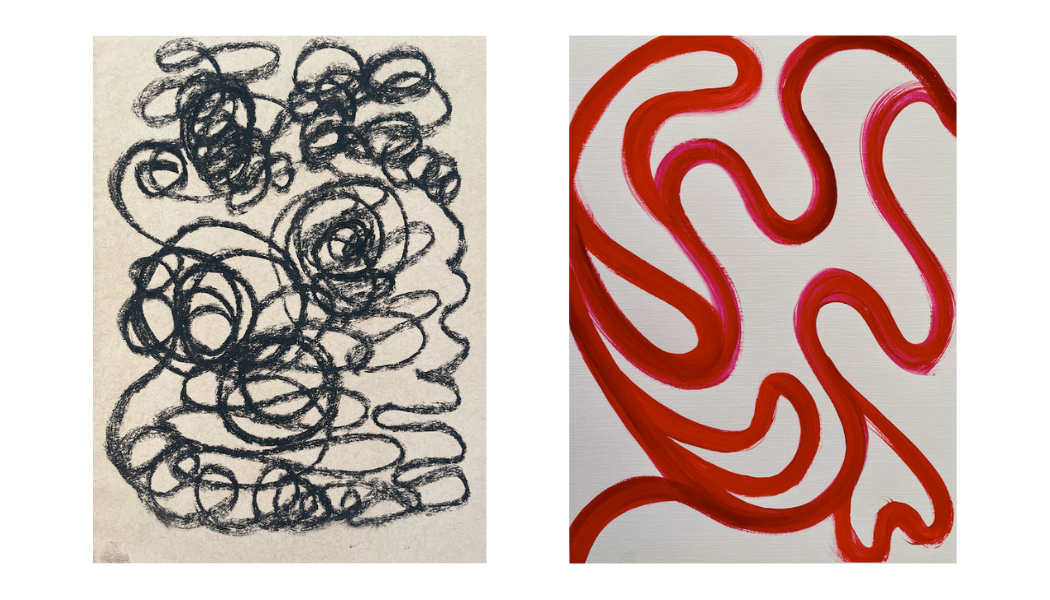
ART I’M MAKING
This week I've been painting my feelings, including the ones I usually avoid: anxiety, overwhelm, confusion, procrastination. My intention is to build my capacity to be present with all of my emotions, which is a radical departure from the usual advice to control our thoughts and feelings.
Sitting with them on paper turned out to be its own small version of playing my opposites. The feeling gets a frame, a time limit, and a place to land.
Here are two from the series: Hello Anxiety and Ready to Play III.
REFLECTION QUESTION
Think of a situation where you always default to the same response. What's one small way you could “play your opposite” this week?
Sources:
Siegel, D. J. (1999). The Developing Mind. Guilford Press. Ogden, P., Minton, K., & Pain, C. (2006). Trauma and the Body: A Sensorimotor Approach to Psychotherapy. W. W. Norton.