In some personal and professional development circles, growth is treated as a solo exercise - something that comes down to willpower and discipline alone. I take issue with this. Hyper-individualism creates the illusion that we're separate from each other, and it frames every shortcoming as a moral failure.
And here's the thing: research in psychology and neuroscience shows that willpower isn't even a character trait; it's a mental function with real limits [1]. So when you're running on motivation alone, you're not just tired. You're running a system that was never built to last.
Gentle accountability invites others into your journey. It's gentle because it's steps removed from hustle culture; that do-or-die, get-your-act-together energy that treats growth like an extreme fitness boot camp. When your motivation dips (and it will), the people around you hold. That's what makes it sustainable.
INNER SUSTAINABILITY INSIGHT
When you're white-knuckling your way through personal growth alone, burnout isn't a sign of weakness but a predictable outcome. Gentle accountability distributes that load. Here are some ways to bring it into your personal life, organized by stress response:
🟥 Fight: you want to learn to relax.
Invite someone to join you in a relaxing activity you can do together. Growth doesn't always have to look like effort.
🟨 Flight: you want to stop procrastinating.
Ask your partner or friend to point out when you're doing chores as a way to avoid making time for your passion project. (Totally me!)
🟦 Freeze: you want to get started, or start again after a setback.
Ask someone for encouragement and to remind you of your progress. Sometimes you just need a witness.
🟩 Fawn: you want to learn to set boundaries.
Practice saying no with someone as a low-stakes way to build that muscle. It counts as reps.
OUTER SUSTAINABILITY INSIGHT
Now think about the next step in your career. For those of you at traditional architecture and engineering firms without built-in sustainability practices: this is where gentle accountability gets practical.
You can't change what you can't measure, but that doesn't mean you need a perfect system before you start. Small, shared steps are the whole point.
🟥 Fight: You want to wow clients without over-perfecting.
If you're tweaking that energy performance report or LEED package instead of sending it, share a draft with a colleague before it's ready. Let their feedback shape it rather than your own spiralling. Done and shared beats perfect and sitting in your drafts.
🟨 🟦 Flight or Freeze: You want to implement sustainability tracking firm-wide but don't know where to begin.
Pick one project and track one thing (ie. energy use intensity, waste diverted, or which green strategies actually made it into the final design). Then share what you learned. One project becomes your proof of concept, and proof of concept makes the bigger ask (such as a firm-wide process, a sustainability committee, a green building checklist) a lot easier to get through the door.
🟩 Fawn: you want to push back when sustainability gets deprioritized mid-project.
You know the moment: value engineering kicks in and the high-efficiency HVAC or low-VOC finishes are suddenly on the chopping block. Before that meeting, practice making the case with a mentor. Walk through the long-term cost savings, the occupant health data, the client's own stated goals. Rehearsing is how you stop softening your message at the moment it matters most.
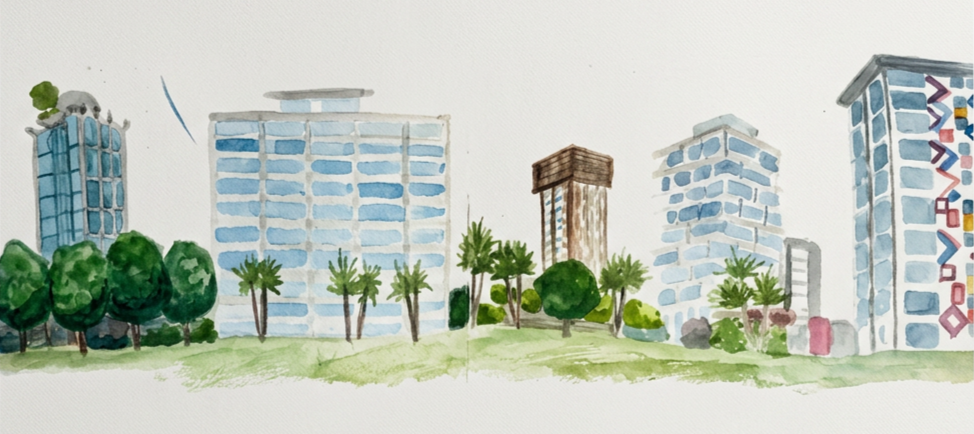
ART I’M MAKING
I recently made this sketch of the Vancouver skyline. I was satisfied overall, except for the blue mark on the top left corner of the page. When I showed it to my partner, he said it looked like a shooting star. And just like that, I smiled and relaxed.
That's gentle accountability in action. Sometimes bringing someone else into your process doesn't just keep you moving; it reframes how you see what you've already made.
REFLECTION QUESTIONS
Where in your work are you over-perfecting or stalling? Who could you bring in to help you move forward?
Source:
Baumeister, R. F., & Tierney, J. (2011). Willpower: Rediscovering the greatest human strength. Penguin Press.