Every building is in a quiet, constant negotiation with physics.
Before a single wall goes up, someone has checked the bearing capacity of the soil. The structural engineer has sized the columns for the compressive load of every floor above, plus the dead load of the building itself. The envelope engineer is thinking about how wind-driven rain will try to find its way into the facade. And the architect is holding all of it at once, while also trying to make the thing beautiful.
We’re trained to see these forces. For most of us, it’s second nature.
Here’s what I keep coming back to, though: physics doesn’t stop at the building. And it doesn’t stop at our skin.
The forces a building is exposed to act on us too. So this issue, I want to borrow four of them, compression, tension, bending, and torsion, and look at what they do to the people doing this work.
INNER SUSTAINABILITY INSIGHT
See if any of these feel familiar:
Compression: You feel squeezed for time. Deadlines stack up like floors above you, and the load keeps coming down.
Tension: You’re being pulled in different directions. Too many projects, too many stakeholders, and you’re stretched thin.
Bending: You’re bending over backwards to keep someone happy, whether that’s a client, your boss, or your principal.
Torsion: You’re going around in circles. Think of the client who changes their mind for the fourth time, and you’re redesigning the same lobby again.
Like a well-designed structure, our nervous system can absorb a lot of this. Most days we flex, redistribute the load, and recover, and everything’s fine.
Other times we get pushed past our limits. Stress turns into strain, and the cracks start to show: shorter fuse, worse sleep, and a creeping sense that you can’t take on one more thing.
Engineers know that plenty of structural failures don’t come from one dramatic overload. They come from fatigue, the same load cycling over and over until something gives. Burnout tends to work the same way.
OUTER SUSTAINABILITY INSIGHT
We don’t design buildings to avoid forces. We design them to carry forces well.
Concrete is a good example. It’s excellent in compression and weak in tension, so we add rebar exactly where the tension is. The reinforcement matches the force.
Strengthening your nervous system works the same way. You’re expanding your capacity to be with these forces, using strategies matched to the load:
Compression → embrace good enough.
Use templates. Share work early when you want feedback, rather than polishing it alone until midnight. I wrote more about this concept in another newsletter post, which is based on the book The Magic of Imperfection by Living Future founder, Jason McLennan.
Tension → decide whether to let go or hold it.
Sometimes the answer is to let go. Delegate the task to a junior team member, or make peace with an area of your life that won’t get your best right now.
Other times, the answer is to hold the tension. I believe this is the crucible of creativity. When two seemingly opposed ideas can’t both work, and you stay with the friction long enough, you often find a third option nobody had considered.
Bending → get clear on your values, then build guardrails.
A guardrail decided in advance is far easier to keep than a boundary you have to defend in the moment. For example: no calls on evenings or weekends.
Torsion → find what’s driving the indecision.
Ask what actually matters to the client. Then translate the indecision into project metrics and set boundaries around them:
“One more iteration is included. Additional rounds will be billed separately.”
“We need a decision by [date] to keep the project on schedule.”
This turns an emotional loop into a project conversation, which is much easier for everyone to have.
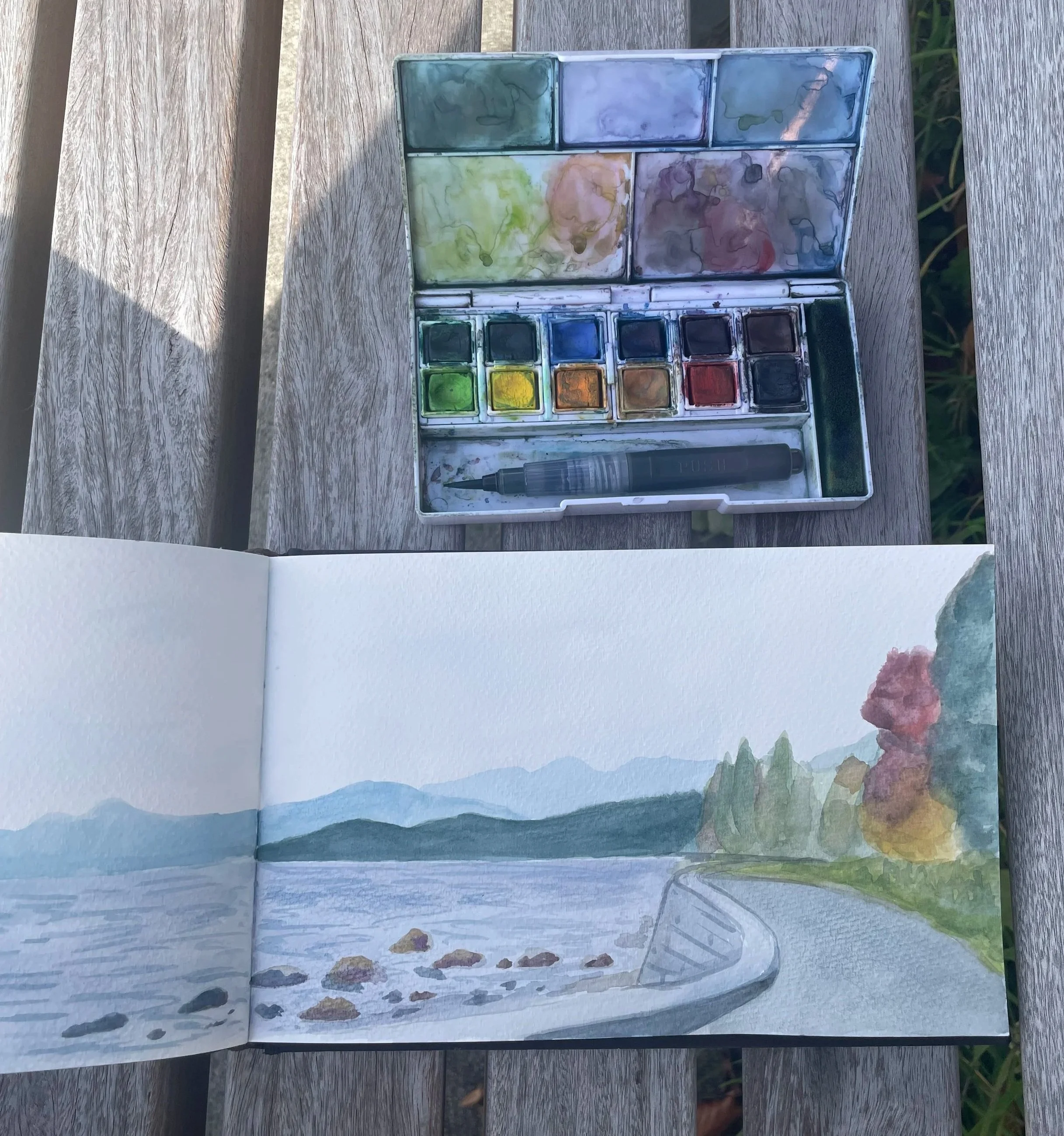
ART I’M MAKING
This fall I’ve been taking my sketchbook down to the seawall. I’ve been enjoying the surprisingly sunny weather, the wind, and the sun on my face, and making quick little sketches while the light keeps changing.