No. 4 Loop-de-Loop: Becoming aware of burnout patterns
This week, I’ve been exploring the neurobiology of burnout. While we often focus on external pressures, deadlines and demands as the main contributor to burnout, research shows that burnout is frequently driven by "unclosed loops", which is the lingering mental and emotional stress cycles we carry through the day.
Thinking of your incomplete to-do list or that performance review with your boss can impact your stress response.
This is referred to as the Zeigarnik effect, which is the brain's tendency to remember unfinished or interrupted tasks, including emotional ones.[1] Additionally, the Somatic Marker Hypothesis proposes that emotional processes guide our behaviour, especially decision-making. [2]
How we navigate these loops depends on our processing style. Some of us are cognitive processors, tackling challenges through logic and mental problem-solving. Others are somatic processors, experiencing the world through physical sensations and deep emotions.
While industry tropes often separate "logical engineers" from "touchy feely designers," the reality is that we all use a mix of both.
Burnout prevention isn't about choosing logic over emotion; it’s about learning to close both types of loops. True resilience isn't about perfection or total control; it’s the ongoing practice of noticing the loops and working through them, one small step step at a time.
INNER SUSTAINABILITY INSIGHT
Over the past year, I’ve been working through closing the loop on workplace social anxiety.
In truth, it’s something I’ve navigated for much longer. Stepping into a more outward-facing role as a Senior Sustainability Consultant simply brought it to the surface in a new way. As an introvert, I suddenly found myself facilitating workshops, leading meetings, and being more visible than felt comfortable.
My emotional loops played out as anxiety in anticipation of the social interactions and mental loops in the form of overthinking what I’d say and do.
This is where inner sustainability came in. It became about learning how to work with the emotional loops underneath the anxiety.
Here are the practices that supported me:
Morning scripting A simple journaling practice. I write two to three sentences about the experience I want to have that day. I anchor into the phrase “it’s safe to be seen” and visualize key interactions ahead.
Grounding in the body Before meetings, I notice where tension lives and breathe into it. Feet planted firmly on the ground, a few deep breaths while people trickle in. Small moments that help regulate my nervous system.
Nature as a reset Stepping into the Zen garden at lunch and letting nature do its work. Sometimes I sketch, inviting small moments of joy back into the day.
End-of-day reflection One minute to capture wins, both big and small. This shifts my focus from what went wrong to what’s working.
Movement and integration at home Yoga flows that focus on opening my chest supported me with learning to stay open in my body when I want to go in a protective stance.
Letting myself be supported Sharing both wins and struggles with my partner keeps me out of overthinking loops and brings me back to perspective.
OUTER SUSTAINABILITY INSIGHT
Alongside the inner work, I needed practical systems to support clear thinking and effective action, which supported me with closing the mental loops, particularly the dreadful anticipation.
This is what outer sustainability looked like for me:
Preparing with intention Jotting down key points before meetings so I am not searching for words in the moment.
Creating boundaries around prep time Setting clear time limits to avoid over-preparing, which is often anxiety in disguise.
Investing in skill-building Using my training stipend to take a communication course and build confidence through competence.
Distinguishing the type of loop I am in This was a turning point. If it is a mental loop, such as feeling underprepared, I respond with research, preparation, or asking for support. If it is an emotional loop, felt in the body, I return to my inner sustainability practices.
Practicing visibility in safe spaces Using internal meetings as a place to practice being seen and heard.
Keeping open communication with my manager Letting them know I am actively working through this created support, accountability, and trust.
This journey is not about eliminating anxiety. It is about building the capacity to move with it.
Inner sustainability helps me feel safe.
Outer sustainability helps me act clearly.
Both are necessary.
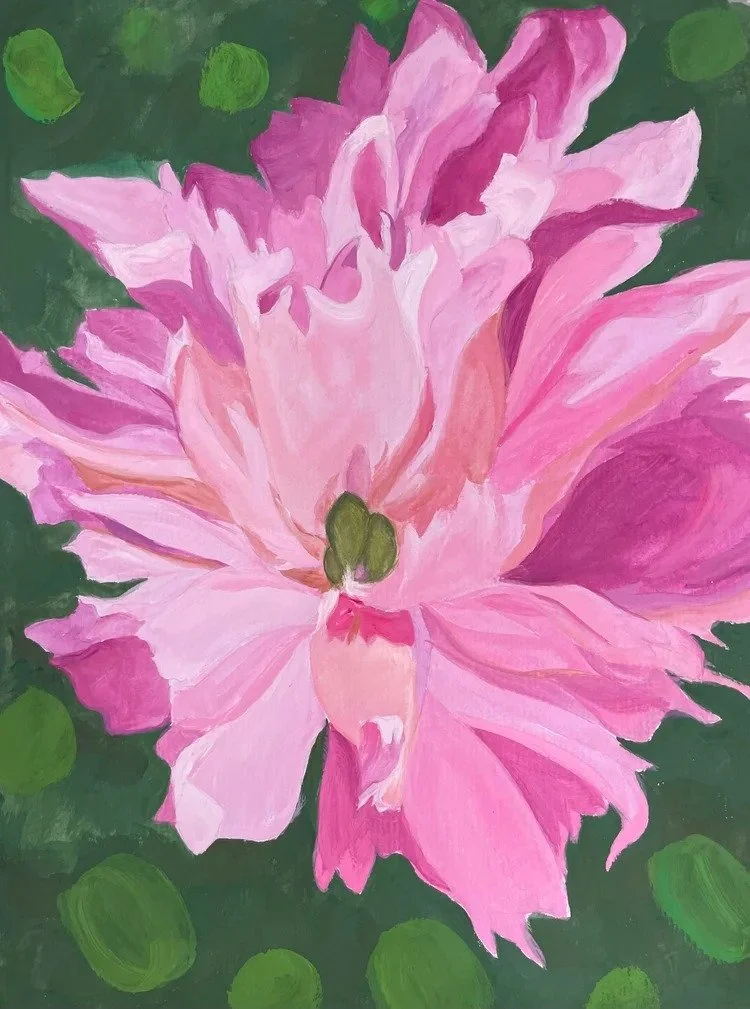
ART I’M MAKING
This newsletter is an ongoing practice in feeling safe enough to be seen. Last week, when social anxiety made writing feel impossible, I pivoted to my canvas and called my sister.
I’ve realized that while my instinct is to "hide out" when anxious, healing happens in connection. By weaving together conversation and colour, the resistance finally broke. I was surprised by how fast this piece emerged; it turns out my daily zen garden sketches and 30-second scribbles have been quietly training me to flow with ease. This artwork is the result of choosing presence over perfection.
REFLECTION QUESTIONS
What is one "unclosed loop" (a difficult conversation, a lingering task, or an old story) that is quietly draining your battery right now?
What is the smallest possible step you can take to close it?
Sources:Zeigarnik, B. (1938). On finished and unfinished tasks. In W. D. Ellis (Ed.), A source book of Gestalt psychology (pp. 300–314). Kegan Paul, Trench, Trubner & Company. https://doi.org/10.1037/11496-025
Damasio, Antonio R. (2008) [1994]. Descartes' Error: Emotion, Reason and the Human Brain. Random House. ISBN 978-1-4070-7206-7. Descartes' Error